
Image Created with DALL – E
Both Approaches Failed Spectacularly
“David’s great at making other people money, but he can’t hang onto his own.”
My dad said this to my mom. I wasn’t supposed to hear it, but I did.
He was right, and it stung because I knew it was true.
I could manage million-dollar operations, oversee complex budgets, make financial decisions that affected hundreds of employees. But my own family’s finances? That was a different story.
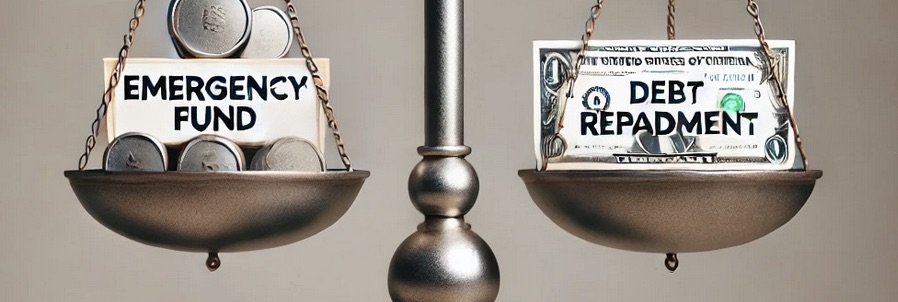
I kept thinking I had to choose between building an emergency fund or paying off debt. Like I could only focus on one financial goal at a time.
Both approaches failed me spectacularly.
The Wake-Up Call I Needed
Dad’s comment came at the end of a particularly rough month. We’d had an unexpected car repair that wiped out what little savings we had, then had to put groceries on a credit card because we’d used our grocery money for the repair.
I was great at making financial decisions for other people’s operations, but terrible at creating systems that worked for my own family.
The irony wasn’t lost on me: I could balance complex business budgets, but I couldn’t figure out how to balance emergency savings with debt payments.
That’s when I realized the problem wasn’t my ability to manage money – it was my approach to managing it.
Why “Either/Or” Thinking Fails Real Families
Most financial advice assumes you live in a controlled environment where life waits its turn.
In real life:
- Kids get hurt during your “debt avalanche” phase
- Cars break down right after you’ve committed to aggressive payments
- Medical bills arrive whether you’re “ready” or not
The “emergency fund first” approach fails because while you’re saving at 2% interest, your credit cards are charging 20%. The math doesn’t work.
The “debt first” approach fails because one emergency sends you backwards faster than months of progress forward.
I learned this by living both mistakes.
What Actually Works: Doing Both Simultaneously
Here’s what we started doing after I finally accepted Dad’s assessment was right:
If this approach sounds familiar, it should. I wrote about this strategy recently because it’s that important – the foundation that makes everything else possible.
Phase 1: Build a Small Buffer Fast $1,000 emergency fund before anything else. Not because it covers everything, but because it covers the most common setbacks without derailing debt progress.
Phase 2: Split Every Extra Dollar Once we had that small cushion:
- 80% of extra money went to debt (highest interest first)
- 20% went to building the emergency fund larger
Phase 3: Adjust Based on Life Stable month with no surprises? More to debt. Kids starting sports season? More to savings. Major appliance looking suspicious? Buffer the emergency fund.
The Psychology That Nobody Talks About
The real challenge isn’t mathematical – it’s mental.
Without an emergency fund: Every unexpected expense feels like failure. You worked so hard to pay down debt, and now you’re adding more.
Without debt progress: Every dollar saved feels wasted while interest charges pile up.
With both: You have resilience AND momentum. That $200 we put in savings instead of toward debt each month? It saved us from adding $1,500 to credit cards when the air conditioner died in July.
Why Your Family Size Matters
We had five daughters. Five.
That meant:
- More medical emergencies
- More school expenses
- More everything breaking at inconvenient times
- More reasons to need both strategies working together
If you have kids, you can’t afford to choose between emergency savings and debt payoff. Life will make the choice for you, and it won’t be pretty.
The Numbers That Actually Matter
Everyone quotes the statistics: “Most Americans can’t cover a $1,000 emergency.”
Here’s the statistic that matters more: Families who build even small emergency funds while paying off debt are 60% less likely to take on new debt during the payoff process.
Progress with protection beats perfection without it.
How Much Is Enough?
Emergency fund: Start with $1,000. Build to one month of expenses. Then three months. Then six months. Do this while paying off debt, not after.
Debt payments: Focus on high-interest debt first, but don’t stop emergency fund progress completely.The split: 80/20 works for most families. Adjust based on how stable your life feels month to month
When Life Happens Anyway
Even with this strategy, we still had months where everything went wrong at once.
The difference? Instead of going $2,000 backwards on debt, we only went $300 backwards. Instead of feeling defeated, we felt like we’d handled life reasonably well. That’s the real win – resilience, not perfection.
What This Looks Like in Practice
Month 1: Save $1,000 emergency fund.
Month 2-12: Split extra money 80% debt, 20% savings.
Month 13: Reassess based on debt progress and emergency fund size. Ongoing: Adjust split based on life circumstances.
When emergencies happen: Use the fund, then rebuild it while continuing debt payments.
The Freedom You Don’t Expect
The most surprising benefit wasn’t financial – it was emotional.
When you have both an emergency fund and a debt payoff plan, money stops being the enemy. It becomes a tool.
Unexpected expenses stop feeling like personal failures. They feel like problems with solutions.
Your marriage gets stronger because you’re not fighting about money every time life happens.
Your kids learn that adults can handle challenges without panic.
Why This Takes Longer (And Why That’s Good)
Yes, this approach means slower debt payoff than the “avalanche” method recommends.
It also means you never go backwards.
It means your progress is sustainable instead of fragile.
It means you build habits that last beyond debt freedom.
The Simple Truth
Your family doesn’t need perfect financial advice. You need resilient financial strategies.
You need systems that work when life doesn’t cooperate with your spreadsheet.
You need both an emergency fund and debt progress, even if it means doing each more slowly.
The families who build lasting financial security understand this. They know that sustainable progress beats sprint-and-crash cycles.
Start with $1,000 in savings. Then split every extra dollar between debt and savings. Adjust as life requires.
It’s not the fastest path to debt freedom. But it’s the most reliable path to financial security. Your future self – the one who handles emergencies without panic – will thank you for building both.
If this resonates, you’re ready for the complete Before the Budget series. I write about the mindset shifts that actually matter — delivered bi-weekly to readers who know there’s more to money than math.
The information in this article is for educational purposes and reflects personal experience. Every family’s situation is different — consult with a financial professional for advice specific to your circumstances.